

On July 25, 2000, a titanium wear strip fell off a Continental Airlines aircraft onto a runway at Paris Charles de Gaulle Airport. Five minutes later, Air France Flight 4590 ran over it at 185 miles per hour. The Concorde crashed. All 113 people aboard and on the ground died.
The debris had been sitting there for five minutes. No monitoring system caught it.
That failure was not about sensor range or camera resolution. It was about what the system knew how to look for and what it didn’t. Foreign object debris on a runway is exactly the kind of hazard that falls between known categories: small, irregular, appearing without warning, looking different every time.
Most infrastructure AI still has the same problem. Trained once, deployed, frozen. The world changes. The system does not.
A Silicon Valley company called Skylark Labs is trying to fix that. Its system, TERRA, is an adaptive intelligence layer for ground infrastructure and autonomous ground platforms that keeps learning from what it encounters after deployment, running on highway corridors in Indiana, naval airfields in India, carrier decks at sea, and defense installations across the Middle East and Europe. Different applications, same adaptive learning architecture underlying them all.
Most infrastructure AI is installed intelligence. TERRA is accumulating intelligence.
Why Infrastructure AI Gets Worse Over Time
The monitoring systems deployed across highways, runways, tarmacs, and defense installations share a common design assumption: train the model on known hazard types, deploy it, and refresh it periodically when performance degrades.
That model has a structural flaw. Real-world conditions are dynamic in ways no pre-deployment training set fully captures. Oil patches appear on runway surfaces between maintenance cycles. Road surface defects emerge in patterns that only become legible after months of observation under real load. Salt spray and vibration on a carrier deck produce false positive signatures that laboratory testing doesn’t reliably predict.
The conventional fix of collecting data, retraining, and redeploying takes months. In environments where conditions change week to week, that lag is why false positive rates climb, operators start ignoring alerts, and hazards slip through.
The deeper issue is architectural. Most infrastructure AI is built to perform at deployment, not improve because of it. Once installed, it is frozen. It cannot incorporate what it learns. It cannot share what one site has figured out with the next site down the road.
“Most infrastructure AI stops learning the moment it is deployed,” says Amarjot Singh, founder and CEO of Skylark Labs. “That means every new installation starts from scratch, even if you’ve already solved the same problem somewhere else.”
An Intelligence Layer, Not a Sensor System — and Not Just Perception
TERRA, which stands for Terrain, Environment, Roads, Runways, and Assets, is not a camera or a sensor array. It is software that sits above whatever monitoring hardware a site already has and makes it adaptive. The architecture spans two interconnected functions: what the system perceives, and what it does about it.
On the perception side, a base detection model handles known hazard categories at deployment. A local adaptation layer sits above it, continuously scanning for signals outside its parameters, such as new debris types, site-specific false positive patterns, and surface conditions the training data never included.
When it finds something new, it learns it from limited operational examples through a local memory layer, not by rewriting the base model, but by accumulating operational context that sharpens classification during ongoing missions. Bounded learning constraints keep adaptation within auditable, safety-appropriate limits because, in a safety-critical environment, a system that learns without constraints creates its own class of risk.
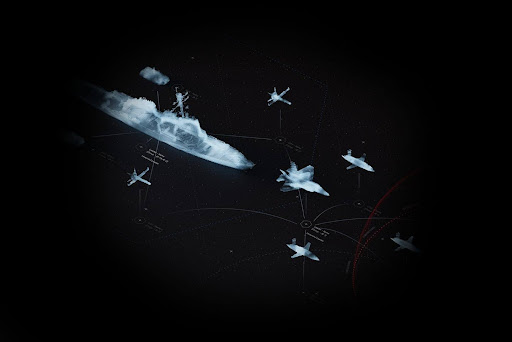
On the control side, the same adaptive layer extends from detection into action. TERRA is an active navigation and control layer for ground platforms—autonomous vehicles, unmanned ground systems, and off-road platforms in unstructured environments. It handles obstacle detection and avoidance in real time, route planning across terrain that no pre-loaded map fully captures, and target approach logic for platforms operating without human guidance.
It manages terrain-adaptive control: adjusting speed, load distribution, and vehicle dynamics across soft ground, slopes, debris fields, and water crossings. In denied environments with no GPS and no connectivity, the system navigates from what it can see and what it has learned.
What the system learns at one site doesn’t stay there. Learned knowledge propagates across the network not as raw footage or operationally sensitive data, but as extracted intelligence that any connected asset can apply without reproducing the original encounter. Raw data stays where it was collected, and only what was learned moves.
That matters in defense, government, and enterprise environments where raw operational data cannot cross institutional boundaries. A naval carrier contributes knowledge about salt spray and deck vibration without transferring footage. An air base benefits from lessons learned at a commercial airport without exchanging operational video. Knowledge sharing without data exposure.
Why This Problem Is So Large — and So Urgent
The scale of the static AI problem in infrastructure is not abstract. It shows up in every domain where the physical world changes faster than monitoring systems were designed to handle.
Foreign object debris on runways kills people. It has done so repeatedly, and the Concorde was not the last incident. The global FOD detection market represents a $14 billion problem that decades of sensor investment have not solved because better sensors are not the answer when the underlying detection model cannot adapt to what it finds.
On highways, aging infrastructure and rising traffic loads are producing failure modes that static monitoring systems were not trained to recognize. Governments across the US, Europe, and Asia are under pressure to maintain safety on infrastructure they cannot afford to rebuild, which means the monitoring systems already installed need to get smarter, not get replaced. The smart highway and infrastructure monitoring market is growing at 10% annually, not because the technology is exciting but because the infrastructure problem is urgent.
In defense, the pressure is most acute. Military installations, naval airfields, and carrier decks operate in adversarial environments, with high operational tempo and rapidly changing surface states, where static AI degrades fastest and the cost of a missed detection is highest. The need for adaptive, data-sovereign ground intelligence is not a future requirement. It is an active operational gap.
Together, the addressable market exceeds $250 billion. But the number is a consequence of the problem, not the point. The point is that every one of these environments is currently running on intelligence that was frozen the day it was installed, and the gap between what those systems know and what the world is actually doing keeps widening.
Proven Across Five Domains
Skylark has secured a $21 million traffic-safety contract spanning 6,000 law enforcement assets in Asia, signed ground infrastructure contracts totaling $20 million, and reports a pipeline exceeding $150 million globally.
Scout Towers with the Indiana DOT monitor highway corridors in real time, learning traffic patterns and debris signatures as conditions evolve. The Tracer AI Vehicle has operated across Indian Navy airfields for two years, hitting sub-1% false positive rates where oil patches and ground crew activity defeat conventional systems.
Fixed detection systems run continuously at Indian Air Force bases and GMR Hyderabad International Airport. A demonstration aboard an Indian Navy aircraft carrier validated TERRA under salt spray, vibration, and high operational tempo at sea. Mercedes-Benz R&D India integrated the adaptive layer into vehicles for real-time accident hotspot detection, fusing edge AI, telematics, and geographic analytics into a live safety signal.
TERRA has been demonstrated to US DoD stakeholders, including the Defense Innovation Unit and the US Air Force. Army Colonel (ret.) Brad Boyd, former Chief of Joint Warfighting Operations at the Joint Artificial Intelligence Center, described Skylark’s adaptive AI approach as “a game-changer” for defense operations.
Five domains. Two continents. One intelligence layer underneath all of it.
Why This Is an AI Story, Not Just an Infrastructure Story
Most AI is designed to perform at deployment. The training phase is where the intelligence lives. If the world changes, you retrain. That works in stable environments. It works poorly in dynamic ones—and most real-world operational environments are dynamic by definition.
TERRA inverts the normal economics of deployed AI. Most systems create a hidden liability over time. They get stale, requiring expensive retraining cycles to maintain performance. TERRA compounds: every deployment adds to the network’s accumulated intelligence, every new site starts smarter than the one before it, and the system becomes more valuable the more it is deployed.
If a debris strip had fallen on that Paris runway today, would a system like this have caught it? That depends on whether it had encountered something similar before, and whether the network it was connected to had.
That is exactly the kind of question the architecture is designed to answer.