

Before Magnolia Pearl became a label collected, resold, and worn by celebrities, it began with a handmade backpack and a private grief. Robin Brown made the bag from kite string and an old tapestry. A stranger bought it in a parking lot for the exact amount Brown needed to retrieve her mother’s ashes from a funeral home.
That origin matters because fashion often asks people to forget where things come from. It sells the clean surface, the perfect seam, and the image of a life untouched by hardship. Magnolia Pearl begins somewhere else. Its story starts with loss, poverty, salvage, and a daughter trying to carry home the remains of her mother.
The brand’s worn-in luxury has found new life because it speaks to a truth the fashion business has spent decades trying to conceal. Clothes are never just clothes. They are records of labor, longing, class, memory, and the human need to be seen.
Luxury With Its Wounds Showing
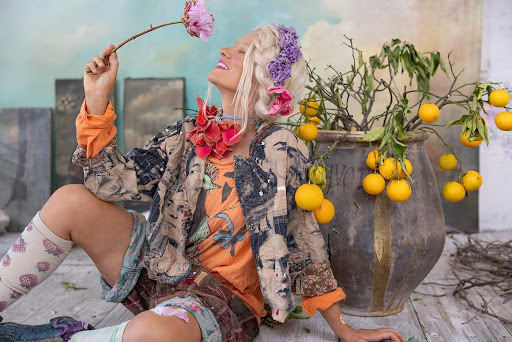
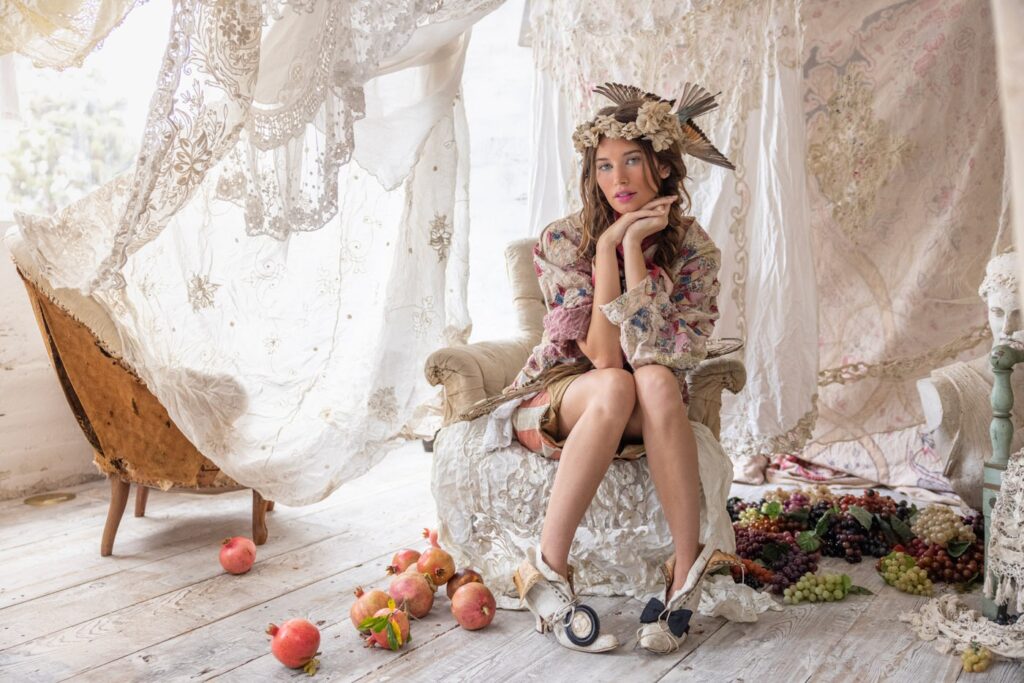
Magnolia Pearl’s garments are not polished in the usual luxury sense. They are patched, faded, softened, painted, frayed, and visibly mended. A jacket may look as if it survived a long journey before it ever reached the buyer. A dress may seem less like a new purchase than a recovered object.
That is the point. Brown’s life story gives the clothes their grammar. She grew up with poverty, abuse, hunger, neglect, and instability. She learned early to see value in discarded materials, and she learned that beauty could be made rather than inherited.
That is why Magnolia Pearl’s clothes carry a strange moral force. They do not pretend that damage never happened. They insist that damage can become part of form. For collectors, that makes the garments feel personal. For celebrities, it offers a visual language that feels softer and more human than ordinary status dressing.
Taylor Swift has worn Magnolia Pearl in a music video. Whoopi Goldberg has worn it on television. Blake Lively has worn it in film. These appearances matter because celebrity wardrobes are rarely neutral. They communicate who belongs, who remembers, who wants to appear untouched, and who is willing to wear evidence of life.
The Market Learns to Value Memory
The rise of Magnolia Pearl’s resale value reveals something larger than brand loyalty. It shows that buyers are beginning to prize clothes that gather meaning after the first sale.
Some Magnolia Pearl pieces have reportedly resold for double or triple their original retail prices through consignment shops, social media groups, and collector networks. The exact value depends on rarity, condition, and demand, but the pattern is clear enough. These garments do not lose all worth once they leave the boutique.
That runs against the old logic of fashion, where newness was worshiped and last season was treated as waste. Magnolia Pearl’s collector market suggests a different economy, one built on scarcity, recognition, and emotional attachment.
Magnolia Pearl Trade, launched in 2023, gives that second life an official home. The authenticated resale platform lets collectors buy and sell pre-loved pieces, while the company releases rare samples and sold-out designs. In a throwaway culture, resale becomes more than commerce. It becomes a refusal to declare an object finished simply because it has been worn.
This is where Magnolia Pearl’s worn-in luxury gains force. The brand is expensive, and it is not free from the contradictions of high-end fashion. Yet it asks a useful question: What if value does not decline with use? What if use becomes part of value?
Philanthropy Gives the Brand Its Weight
Magnolia Pearl’s story would be thinner if it stopped at celebrity and resale. The deeper claim is service.
The Magnolia Pearl Peace Warrior Foundation, founded in 2020, has raised more than $550,000 for causes including housing for Indigenous American veterans, food and medical care for unhoused people and their pets, wild horse protection, arts education, and disaster relief. Magnolia Pearl Trade also directs 25 percent of the final value of Magnolia Pearl Exclusive listings and all third-party seller fees to charity through the foundation.
Purpose-driven fashion deserves scrutiny. Donation figures should be documented. Beneficiaries should be named. Good intentions should never be allowed to substitute for public accountability.
Still, Magnolia Pearl’s model is worth noticing because it links beauty to obligation. A garment moves from maker to buyer, from buyer to collector, and from resale to charitable giving. The piece carries more than fabric. It carries a small transfer of care.
That may be why the brand resonates now. People are tired of flawless surfaces. They know the planet is drowning in discarded clothing. They know many luxury objects are built on silence. Magnolia Pearl offers no total answer to those problems, because no fashion brand can.
What it offers is a symbol with weight: the mended seam. It says that what has been torn does not have to be thrown away. It says that beauty can come from poverty without romanticizing poverty. It says that survival may leave marks, and those marks may be worth honoring.
Magnolia Pearl’s worn-in luxury is finding new life because it tells the truth many polished things avoid. Nothing human remains untouched. The question is whether what has been touched, hurt, carried, repaired, and passed on might be the most valuable thing left.