

Byline: Mae / Baden Bower · Photo courtesy of Milton Coffee Co.
Plenty of new coffee machines start life as someone else’s design. A brand licenses a supplier’s platform, picks a shell and a color, and puts its logo on the front. It’s a fast way to get a product to market, and it leaves the most important decisions to a factory the customer will never hear about.
Milton Coffee Co. went the long way. The Georgia company’s Line1 espresso machine is entirely proprietary, designed and engineered in-house over about 18 months. The project began with a question most of the category had stopped asking: what is actually happening inside a capsule machine?
Phase one: rethinking the brew path
The first decision concerned materials. In most capsule machines, plastic components sit in the part of the machine where hot water, pressure and coffee interact. That keeps costs down, and Milton’s founder, Matt Kossoff, believes it also affects taste.
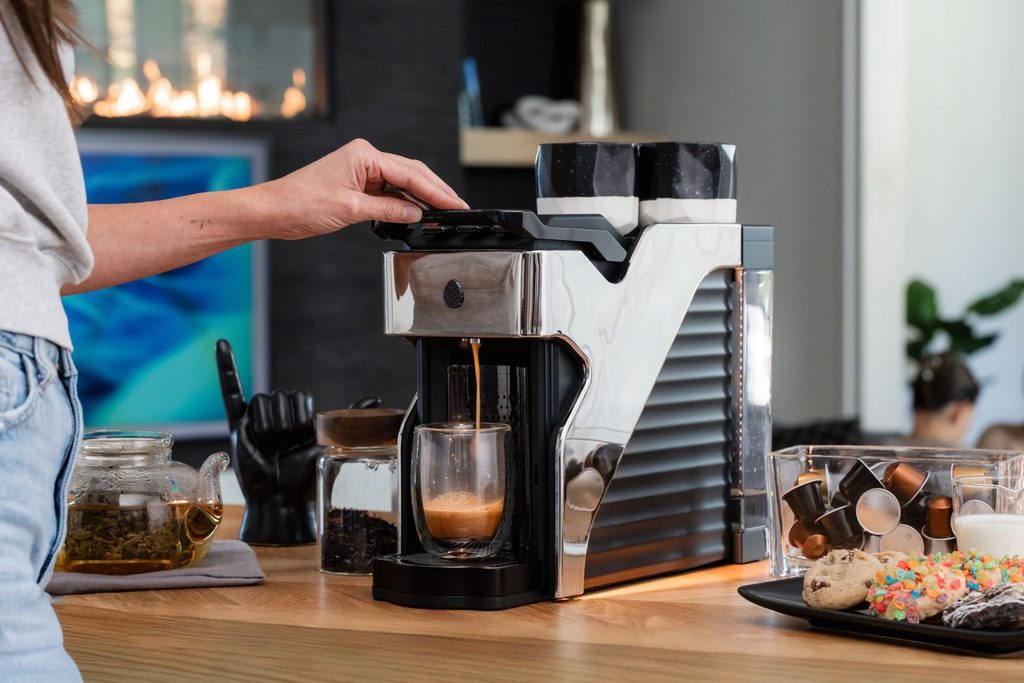
Milton replaced those parts with a stainless steel brew system, which the company describes as the first in a pod-based coffee machine. The change was meant to improve extraction and consistency, and to help the machine hold up to years of daily use.
Phase two: tuning for coffee Milton doesn’t make
A company with its own proprietary pod can tune its machine to one kind of capsule. Milton chose compatibility with Nespresso OriginalLine capsules instead, a widely used format that independent roasters produce for. That meant the Line1 had to brew well with coffee made by many different companies.
To prepare for that, the team evaluated capsule coffee from more than 200 specialty roasters worldwide. The results shaped the machine’s internal architecture, which Milton built specifically to perform with third-party capsules. Milton now also curates capsules from nearly 30 independent roasters, sold alongside the machine.
Phase three: features borrowed from high-end espresso
The engineering team then added features more often found on expensive espresso equipment. Pre-infusion wets the coffee before full pressure arrives, which helps extraction. An automatic rinse runs after each brew to keep the internals clean. A single interface with metal controls handles espresso, coffee and hot water.
What the team left out was just as deliberate. The Line1 has no app, no connectivity and no menu of settings to adjust. Kossoff sees the trend toward connected, feature-heavy coffee machines as a complication people don’t need first thing in the morning.
“Every aspect of the Line1 platform has been developed from the ground up to challenge assumptions in a category that has remained largely unchanged for years,” Kossoff says.
Phase four: finishes and production
With the internals settled, Milton turned to the outside. The company offers ready-to-ship Classic models and Signature designs, plus fully custom builds. Custom machines are finished by hand in Milton, Georgia, in materials that include wood, leather, hand-hammered metal and carbon fiber. The Line1 carries a limited lifetime warranty.
By the time Milton opened pre-orders, the Line1 had completed development and entered mass production. The company reported just over 100 pre-orders during its pre-launch phase, without any paid marketing, spread across standard and customized machines.
What the long build bought
Building from scratch costs time and money that a licensed design would have saved. For Milton, the return was control over the part of the machine that decides how the coffee tastes. When a customer’s espresso is good or bad, the cause sits inside a system the company designed itself.
It also gives Milton a platform it owns outright as it grows. The company plans to follow the United States with Canada and then select European markets, and it sees hotels as a future customer for the same machine.
Eighteen months is a long time to spend on a product before selling it. Kossoff’s view is that the machine only works if the engineering does, and a borrowed design wouldn’t have given him the brew path he wanted.