

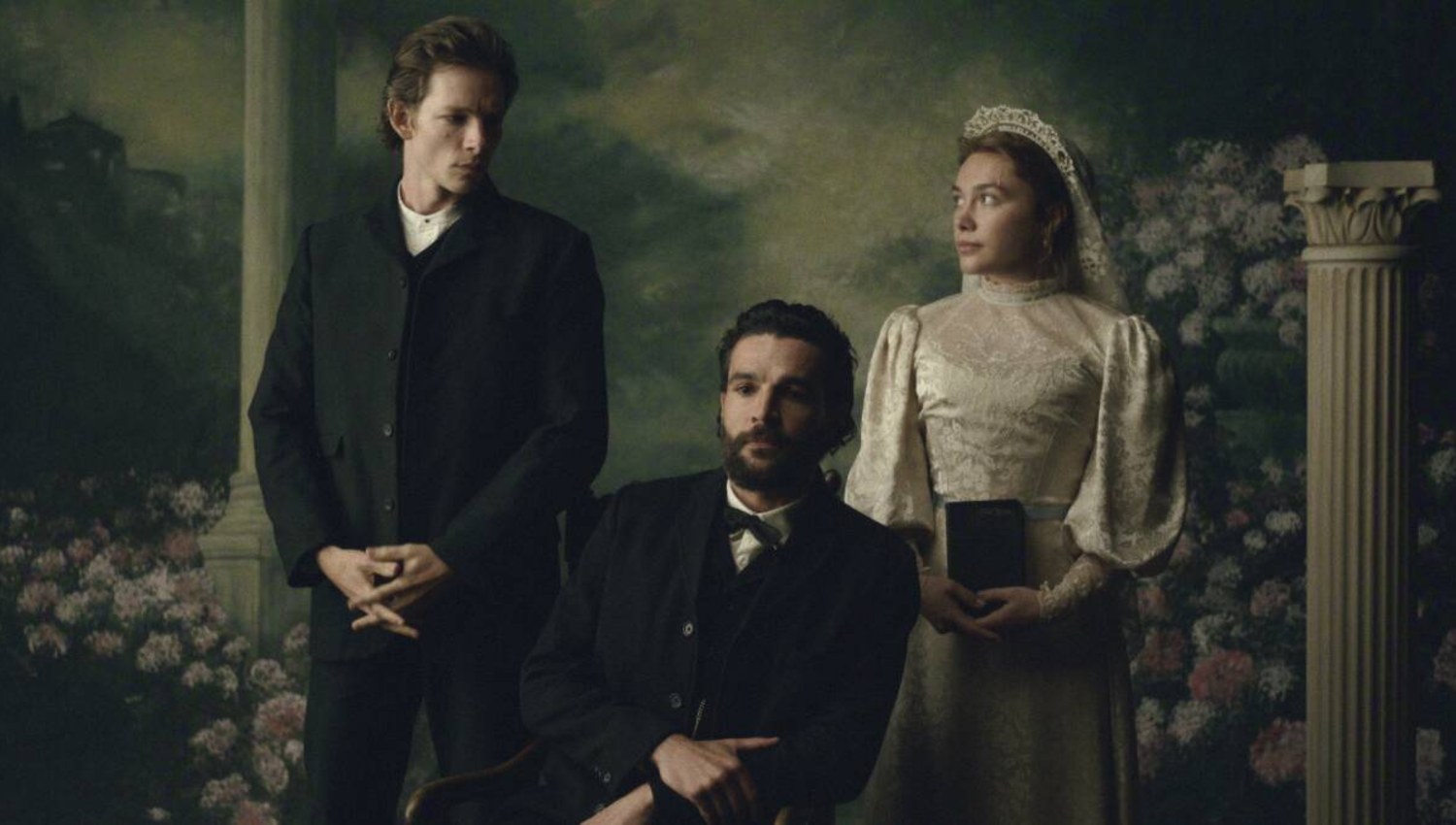

Some literary characters endure because they resist easy explanation. Cathy Ames, the unsettling presence at the heart of John Steinbeck’s East of Eden, belongs to that company. In Netflix’s new seven-episode adaptation, Florence Pugh takes on a woman whose influence reaches across generations, bringing a more intimate perspective to a story defined by family rivalry, withheld affection and the uneasy boundary between good and evil.
Written and executive produced by Zoe Kazan, the limited series revisits Steinbeck’s 1952 novel through the intertwined lives of Cathy and the Trask family. Christopher Abbott plays Adam Trask, while Mike Faist portrays his brother Charles. Their relationships form the foundations of a drama in which private wounds become an inheritance, shaping lives long after the events that created them.
Yet this adaptation does more than extend a familiar story across several hours of television. Its defining shift is one of perspective. Cathy receives greater room to explain herself, including through narration that previously belonged to Steinbeck’s authorial voice. That change invites audiences closer to a character whose actions remain disturbing, creating tension between understanding her history and judging what she does with it.
The Woman Behind the Menace
Pugh’s Cathy is not simply a villain softened for contemporary tastes. The adaptation gives her a more explicitly traumatic childhood, including an abusive father, while preserving the manipulation and cruelty that make her such a dangerous presence. The result is a portrayal built around an uncomfortable question: How much can an explanation illuminate a person without becoming an excuse?
That distinction has become central to the series’ critical reception. Gulf News praised Pugh’s performance while examining how the adaptation recontextualizes Cathy’s origins. The Washington Examiner likewise noted the added sympathy but argued that Pugh retains the character’s wickedness. Across those readings, the performance emerges as a balancing act, bringing vulnerability and calculation into the same frame without allowing either to cancel the other.
The role also gives Pugh an unusually expansive character journey. Cathy’s story stretches from girlhood to her later reinvention as Kate, allowing the actor to trace a life rather than capture a single decisive chapter. Pugh also served as an executive producer and collaborated with Kazan and the creative team. That involvement connects her performance to the larger effort to give Cathy a fuller presence within the adaptation.
A Family Story Behind the Adaptation
For Kazan, East of Eden carries an inheritance beyond its fictional families. Her grandfather, Elia Kazan, directed the celebrated 1955 film adaptation starring James Dean. Returning to the same novel places her work in conversation with a landmark interpretation, but the new series follows a different path. Where the film largely concentrated on the novel’s final section, television offers space to explore the earlier experiences that shape the Trask family.
The opening stretch follows Adam and Charles through their harsh upbringing before bringing their lives into contact with Cathy’s. Abbott and Faist anchor a brotherly relationship marked by unequal affection and competing responses to paternal authority. By spending time with that earlier generation, the series makes the later family conflicts feel less like isolated eruptions and more like consequences of patterns already established.
Still, greater length should not be mistaken for complete coverage. NPR’s review observed that the roughly seven-hour adaptation substantially reduces the novel’s Irish American family strand, even while expanding Cathy’s story. That limitation clarifies the production’s priorities. This is not an attempt to give every element of Steinbeck’s world equal weight, but a selective interpretation that places particular emphasis on Cathy, the Trasks and the moral pressures surrounding them.
The Question That Survives Every Generation
Beneath its period setting and multigenerational scope, East of Eden returns to a stark idea: choice. Netflix describes the struggle between good and evil as central to Kazan’s interpretation, alongside the ways family history shapes an individual’s present. The connection matters because inheritance can explain a character’s circumstances without necessarily determining every decision. The drama asks whether people can act differently from those who hurt or failed them.