
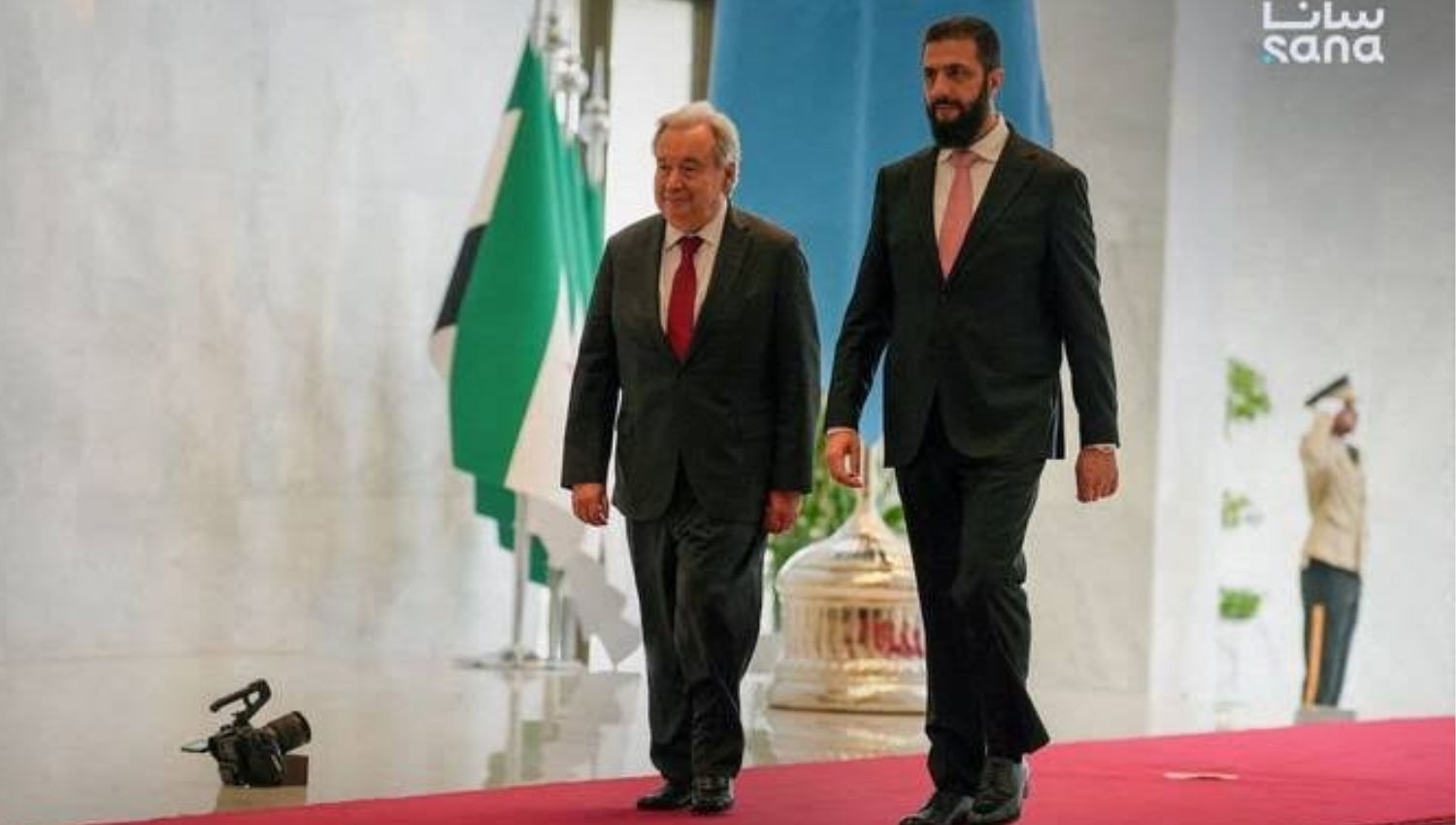
DAMASCUS: UN Secretary-General Antonio Guterres pledged support for Syrian reconstruction on Saturday during the first visit to Damascus by a serving United Nations chief since 2009, before the outbreak of a civil war that killed hundreds of thousands and displaced millions.
Syrian President Ahmad Al-Sharaa received Guterres at the presidential palace in Damascus, state news agency SANA reported, without offering further detail. “No country emerges from a very severe conflict and rebuilds itself on its own,” Guterres said after the talks, speaking at a joint press conference with Foreign Minister Asaad Al-Shaibani. “We must help Syria in its determination and resolve to do so.”
Shaibani renewed Syria’s call for greater support from the international community, particularly the European Union. He said the discussions with Sharaa, which he also attended, had focused on increasing UN support for reconstruction and on a government plan to close displacement camps. Sharaa, the former head of Al-Qaeda’s affiliate in Syria, was until November 2025 under terrorism-related sanctions imposed by the UN Security Council.
A Milestone for Syria’s Leaders
Guterres’ visit marks another milestone for Syria since rebels ousted President Bashar Assad in late 2024, ending the war that began in 2011 and opening a transitional period led by Sharaa. At the time, Guterres described “the end of the Syrian dictatorship” under Assad as a sign of hope for the region.
In a post on X on Saturday, which he called a “visit of solidarity,” Guterres wrote that the United Nations stands with Syria at this pivotal moment. He is also due to meet other government officials and representatives of Syrian civil society, and is expected to address the country’s parliament on Monday, UN spokesperson Stephane Dujarric said earlier in the week. During the visit, Dujarric said, Guterres would stress that the country has an opportunity not only to recover from conflict but to lay the foundations for a future that is more stable, more inclusive, and more prosperous for all Syrians.
A Return to the Global Stage
Guterres is expected to remain in Damascus for several days, though his office has not released a full schedule. The trip comes just weeks after two bombs exploded near a hotel in Damascus where French President Emmanuel Macron had spent the night, overshadowing the first visit to Syria by an EU head of state since Assad’s fall.
Sharaa’s government is working to rebuild Syria’s international ties and its economy after nearly 14 years of war and decades of isolation under Assad family rule. The transition has been marred by two major episodes of sectarian bloodshed that have tested Sharaa’s repeated pledges to protect the country’s religious minorities. Nearly 1,500 Alawites, the sect to which Assad belongs, were killed in Syria’s coastal region last year by government-aligned factions, and hundreds of Syrians from the Druze minority were killed months later in the south. Guterres expressed alarm over both bouts of violence and has called for accountability.
Sharaa, who broke ties with Al-Qaeda in 2016, led an alliance of Islamist rebel factions that ousted Assad in a lightning offensive in December 2024. Since taking power, his government has sought to broaden Syria’s diplomatic relationships beyond Assad’s longtime allies, Russia and Iran. Last year, Sharaa became the first Syrian president since 1967 to take part in the UN General Assembly in New York. The United States has lifted most of its sanctions on Syria, and President Donald Trump told Sharaa earlier this month that he intended to remove the country from Washington’s list of state sponsors of terrorism.
Guterres is also expected to visit a UN peacekeeping force that has maintained a buffer zone between Israeli and Syrian forces for decades. Israeli troops have occupied new areas in southern Syria since Assad’s removal, and Damascus has demanded they withdraw and return to the terms of a 1974 disengagement agreement.