

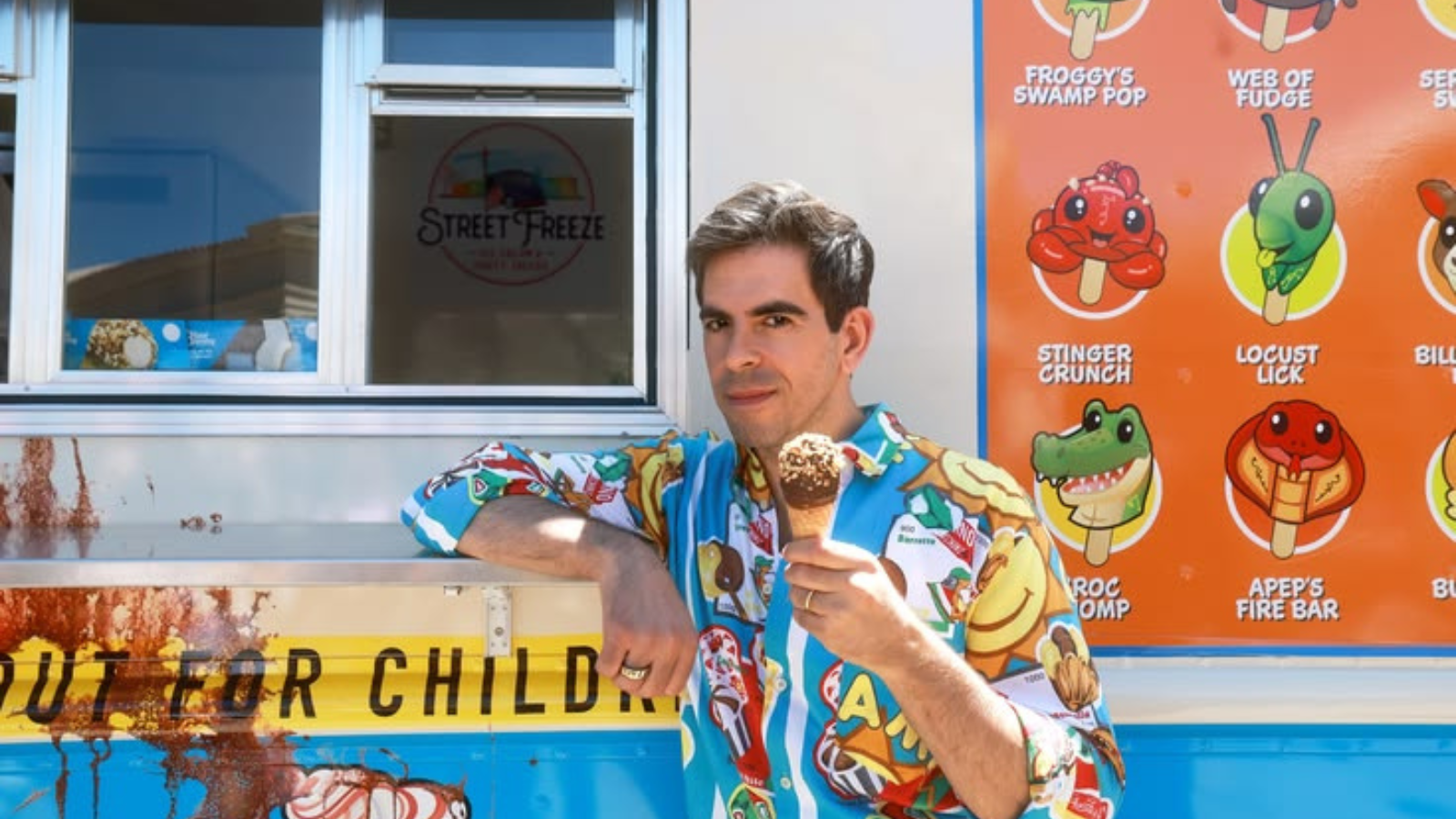

The first look at Eli Roth’s upcoming horror film “Ice Cream Man” confirms what genre fans have suspected for months: this is not a nostalgic trip to the neighborhood truck, but a full‑blown summer nightmare. With the teaser trailer now live and a new poster in circulation, Roth is signaling a return to feral, practical‑effects‑driven terror that leans into his reputation for going further than studio horror typically allows. Set for an August 7, 2026 theatrical release, the movie is already positioning itself as the season’s most deranged counter‑programming to bright, family‑friendly fare.
A Sweet Summer That Curdles Into Chaos
On its surface, “Ice Cream Man” unfolds in Bayleen Bay, a postcard‑perfect summer town that feels ripped from a vintage travel brochure: sun‑bleached boardwalks, gently swaying trees, kids racing toward the jingle of a truck promising cold relief from the heat. That visual comfort is precisely the point, because Roth uses that small‑town ease as the launchpad for a story in which innocence doesn’t just disappear, it mutates. According to the film’s logline, the town descends into madness when a mysterious ice cream vendor starts serving frozen treats that turn children into homicidal killers, weaponizing the very image of childhood delight.
The teaser wastes little time making that premise uncomfortably real. Quick, unnerving flashes show children turning on parents and teachers with brutal tools, their faces smeared not with chocolate but with blood, while the cheery echo of the truck’s music becomes a kind of audio taunt. It’s the classic Roth formula: take something familiar, twist it until it feels wrong, and then hold the camera just long enough for the audience to question how much they actually want to keep watching.
Beneath the gore is a concept Roth has reportedly been nurturing for more than two decades, an idea he has described as one of his most extreme and uncompromising. Early iterations were considered too intense for major studios, pushing the filmmaker toward a more independent path that allowed him to preserve the story’s nastier edges. That creative autonomy is evident in the teaser’s unapologetic tone, which feels less like a cautiously market‑tested release and more like the work of a director daring audiences to follow him into the deep end.
Roth’s Most Unrestrained Vision Yet
“Ice Cream Man” is directed and co‑written by Roth, working from an idea that has lingered since the early days of his career, and co‑scripted with Noah Belson. The film reunites him with the kind of scrappy, genre‑driven production pipeline he thrived in before his name became shorthand for a particular brand of mainstream horror extremity. Financing from The Horror Section and Media Capital Technologies has allowed the project to embrace an unrated edge, leaning into effects and sequences that would likely buckle under studio oversight.
Front and center is Ari Millen, whose genre credentials, including work on “Orphan Black,” make him a fitting choice to embody a character who must be equal parts charming, unsettling, and unreadable. He leads an ensemble that includes Benjamin Byron Davis, Karen Cliche, Dylan Hawco, Sarah Abbott, Shiloh O’Reilly, Kiori Mirza Waldman, Charlie Zeltzer, Charlie Storey, and Roth himself in a supporting role. The casting tilts toward performers who are comfortable living inside heightened material, which is crucial when the script asks adults to react believably as their own children become the monsters in the room.
There’s also a cultural curiosity baked into the project: a horror film built around an image that is universally recognized, almost aggressively harmless. By weaponizing the ice cream truck, Roth plugs into the genre’s long tradition of corrupting safe spaces, but here the metaphor feels unusually pointed. In a media landscape where nostalgia is often sold as comfort, “Ice Cream Man” appears ready to argue that the things we romanticize from childhood can harbor darker, more chaotic impulses just beneath the surface.
Teaser, Poster, And A Vegas Spectacle
The newly released teaser arrives alongside a poster that captures the film’s balancing act between kitsch and menace. The imagery leans into bright, carnival‑style color, but there is a rot at the edges: the suggestion that something toxic is seeping into the swirl of pastel and chrome. Rather than hiding the film’s brutality, the marketing frames it as a selling point, inviting audiences to “scream for ice cream” while hinting that the real attraction is the chaos that follows.
Roth and the team are also turning the promotional campaign into an experience. During CinemaCon in Las Vegas, fans are promised a full activation outside Caesars Palace, complete with exclusive merchandise, “killer” photo opportunities, and an appearance by Roth himself within a tightly scheduled window. The ice cream truck isn’t just a prop in the film; it becomes a roaming piece of marketing theater, blurring the line between the fictional Bayleen Bay and the very real crowds lining up on the Vegas strip.
That strategy reflects a growing trend in horror releases: building a world around the film before audiences ever sit down in a darkened theater. For “Ice Cream Man,” that world hinges on the unsettling notion that evil can arrive with a smile, a jingle, and a perfectly swirled cone. By the time August rolls around, the film’s central image may feel disturbingly familiar, even to those who haven’t yet watched a single frame beyond the teaser.