
Sharjah used a logistics summit in Singapore to make its case for a bigger slice of the trade moving among Asia, Africa and the Gulf, presenting its free zones, customs services and ports to international investors.
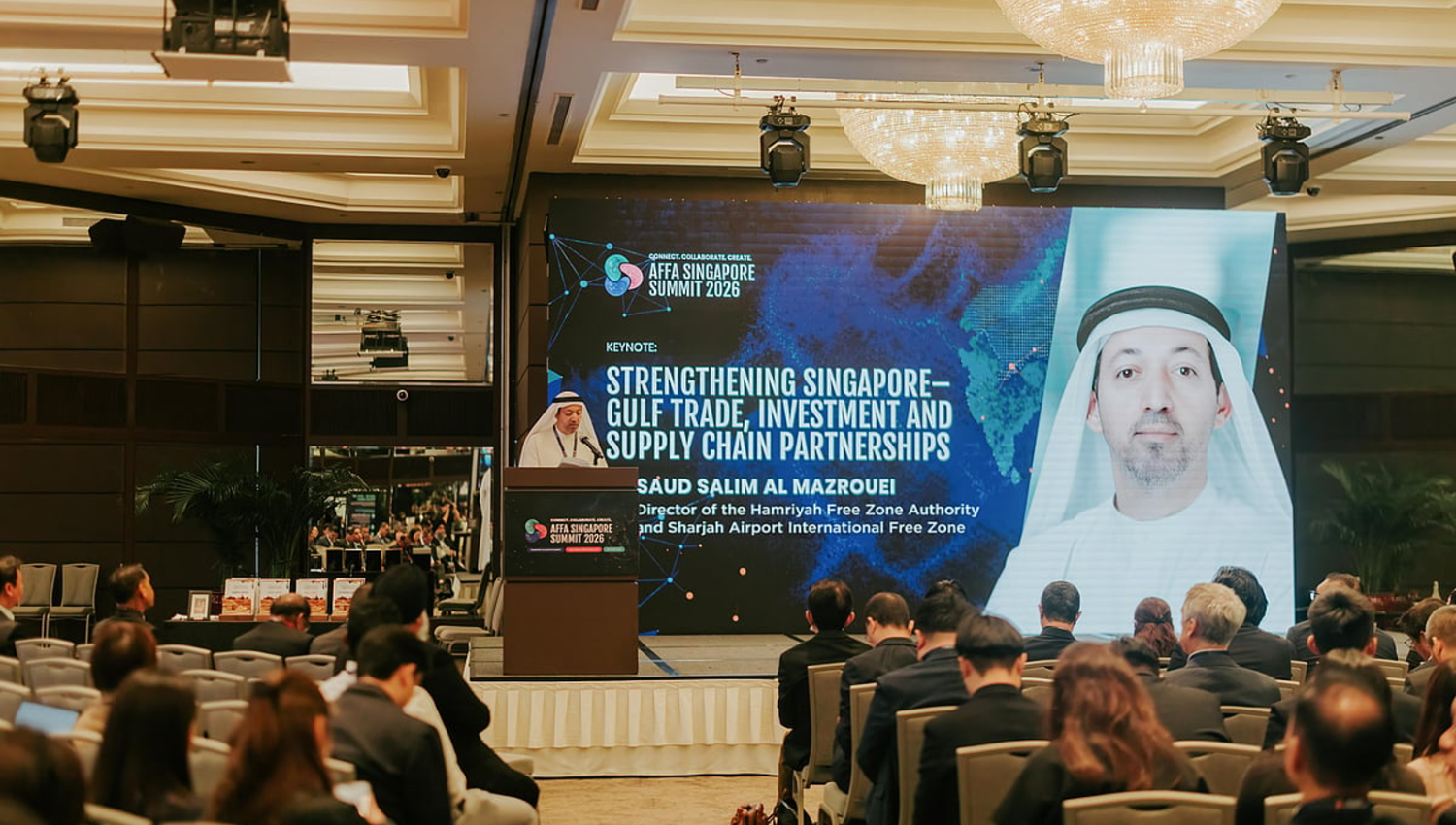
The emirate’s Sharjah Ports, Customs and Free Zones Authority (SPCFZA) took part in the ASEAN Federation of Forwarders Associations (AFFA) Singapore Summit 2026. The Singapore Logistics Association organised the event, which gathered logistics companies, industry bodies and government officials to discuss digital transformation, cross-border links and more efficient supply chains.
Saud Salim Al Mazrouei, who heads both the Hamriyah Free Zone Authority (HFZA) and the Sharjah Airport International Free Zone Authority (SAIF Zone), told delegates that a logistics hub’s edge now rests more and more on offering flexible shipping options and joining up transport, warehousing, customs and distribution.
Because Sharjah has ports on both its east and west coasts, companies can spread their trade across more routes and make their supply chains more resilient, he said.
He singled out Khorfakkan Port, which sits on the Gulf of Oman beyond the Strait of Hormuz with an opening straight onto the Indian Ocean, as another gateway for global shipping. Plans call for its yearly capacity to reach 5 million TEUs, or twenty-foot equivalent units, and eventually 10 million.
Al Mazrouei also said quick customs clearance, digital tools and fast transfers of cargo between free zones, land crossings and ports are needed to stay competitive.
Together, SAIF Zone and Hamriyah Free Zone are home to over 15,000 companies from around 160 countries, working in manufacturing, trading, warehousing, distribution and re-exports. Hamriyah is linked directly to Hamriyah Port, which serves industrial and maritime users, while SAIF Zone sits close to Sharjah International Airport, which helps air cargo businesses.
He said plans by the UAE and Singapore to start talks on a Comprehensive Economic Partnership Agreement (CEPA), on top of agreements already in place with Southeast Asian countries, open the way for closer trade and investment links. He named five areas for cooperation: manufacturing, maritime technology, re-exports, warehousing and logistics.
Calling Singapore a gateway to Southeast Asia, Al Mazrouei said Sharjah gives Asian companies a route into South Asia, Africa, the Middle East and the GCC. He invited firms and industry groups to look at investing via business meetings, trade missions and programmes aimed at particular sectors.
Based on reporting by Khitam Al Amir for Gulf News, November 25, 2026.