
In the late 1990s, the idea of building a private medical college in Ajman carried more than the usual risks of a new educational venture. The UAE’s healthcare landscape was developing rapidly, and the need for locally trained medical professionals was becoming increasingly clear. Into that moment stepped Dr. Thumbay Moideen, whose decision to establish Gulf Medical College in 1998 set in motion what would become one of the region’s most recognisable academic healthcare stories.
Nearly three decades later, Thumbay Group has grown beyond its origins in medical education into an integrated network spanning universities, hospitals, clinics, diagnostics, pharmacies, research and wellness-led businesses. Its progress reflects a wider UAE narrative: an ambition to build institutions that do not simply deliver services, but create the specialists, systems and knowledge needed to sustain a fast-growing society.
A Vision Rooted in Ajman
Thumbay Group was founded in 1997, following an invitation to Dr. Moideen to establish a private medical college in Ajman. At the time, it was a significant undertaking for an expatriate entrepreneur, but the project aligned with the emirate’s broader drive to invest in education and human development. Gulf Medical College opened the following year, creating a new pathway for students pursuing medicine and health sciences in the UAE.
That institution would later become Gulf Medical University, the flagship of the group’s education portfolio. The transformation from a single college into a university with a broad health-sciences focus illustrates how the organisation has expanded alongside the country’s needs. What began with medical education evolved into a model in which students could learn within an ecosystem connected directly to hospitals, laboratories and clinical settings.
Today, GMU serves roughly 5,000 students from more than 111 nationalities and offers over 50 accredited programmes across seven colleges. Its international character is central to its identity, bringing together aspiring healthcare professionals from a wide range of cultural and professional backgrounds while building academic and research ties with more than 70 global institutions.
Learning Where Care Happens
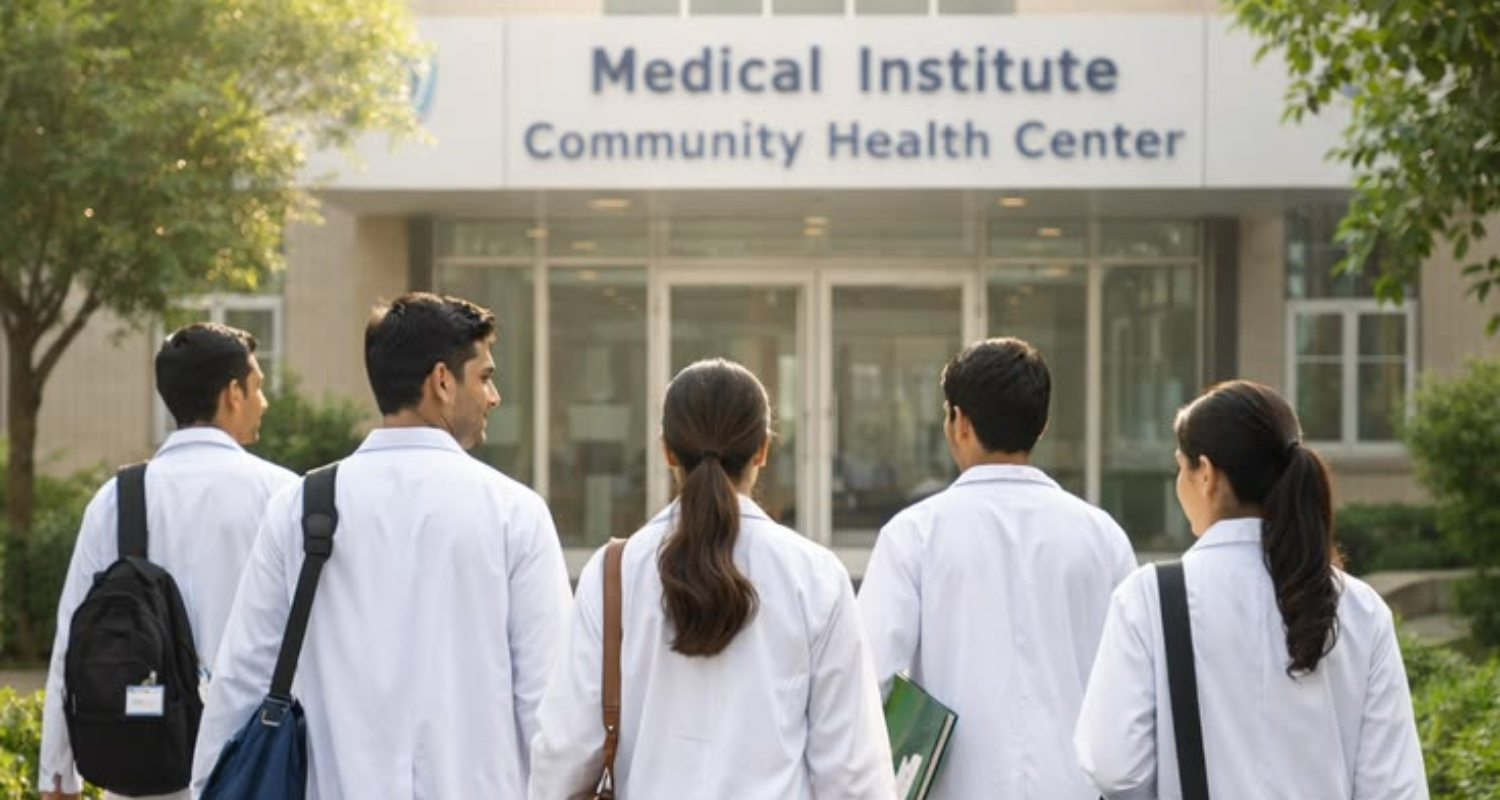
The most distinctive aspect of Thumbay Group’s growth may be the relationship it has built between the classroom and the clinic. Medical education cannot exist only in lecture halls; it relies on exposure to patients, technology, multidisciplinary teams and the practical decisions that shape real care. By developing hospitals and clinical facilities alongside its academic operation, the group has created a more continuous route from student training to professional practice.
Its healthcare network now includes academic hospitals, clinics, medical centres, diagnostic laboratories and pharmacies. This structure enables clinical environments to serve a dual role: they are places where patients receive care, but also living learning spaces where future doctors, nurses, pharmacists and allied health professionals develop their skills under supervision.
The scale of that connection has meaningful implications for the UAE healthcare workforce. Thumbay Group has reported that its university and teaching-hospital network contribute to the training of approximately 20 percent of doctors and around 60 percent of health professionals graduating in the country. These figures demonstrate why private institutions can play an important role in national capacity-building, particularly as demand increases for specialised and patient-centred healthcare services.
Building an Ecosystem, Not Just Institutions
The group’s expansion did not follow a conventional, single-sector path. Instead of treating education, healthcare and research as separate businesses, Thumbay Group has worked to connect them through an academic health system. The model recognises that better clinical outcomes are often tied to stronger education, accessible diagnostics, research activity and an operational environment that supports patients beyond a hospital visit.
Thumbay Medicity in Ajman embodies that approach. Conceived as a hub for education, treatment, research and related services, it represented a major investment in creating an environment where medical learning and healthcare delivery could operate side by side. Earlier reporting described the development as a private-sector regional hub combining advanced education, healthcare and research infrastructure.
The group’s reach also extends into pharmacies, diagnostic services and consumer-facing health and lifestyle offerings. Such diversification reflects an increasingly important reality in modern healthcare: wellbeing is not confined to an emergency room or consultation suite. It includes prevention, early testing, access to medicines, rehabilitation and a more informed relationship between communities and the healthcare systems that serve them.
The Next Chapter of Regional Care
As Thumbay Group enters its 30th year in the UAE, its story is less about a single anniversary than about institutional momentum. The organisation has treated and screened millions of patients over its history, while its education arm has produced thousands of graduates who have moved into healthcare roles in the UAE and beyond.
Its continuing relevance will depend on how effectively it adapts to the next phase of medicine. Healthcare is being reshaped by digital tools, data-driven diagnostics, more specialised treatment pathways and higher expectations from increasingly informed patients. For academic health systems, the challenge is to ensure that technological progress remains connected to clinical judgment, ethical standards and the human experience of care.
Thumbay Group’s journey offers a useful example of how a regional enterprise can grow by anchoring commercial expansion in a long-term social need. From an early medical college in Ajman to a diverse academic healthcare network, it has placed education at the centre of healthcare delivery. In doing so, it has helped turn the training of tomorrow’s professionals into an active part of caring for communities today.