

There was a time when the only way most people saw New York Fashion Week was through the filter of someone else’s eyes. The shows flickered through grainy backstage photos, carefully edited magazine spreads, and, later, tightly controlled livestreams. The room itself—the air, the silence before the music, the split second when a model turns and looks directly at you—belonged to a small, credentialed minority. That division between those on the risers and everyone else was not an accident; it was a hierarchy, reinforced season after season.
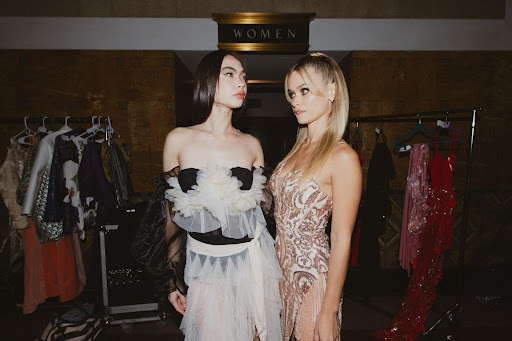
Today, at Gotham Hall on Broadway, that hierarchy is being rewritten in small but telling ways. The room still glows gold. The runway is still polished to a shine. But next to editors and buyers sit paying guests: junior stylists, freelance photographers, emerging designers and, increasingly, people who work in fashion yet never had the kind of access their bosses once took for granted.
A Ticketed Gate to a Once-Closed Room
The Bureau Fashion Week’s February 2026 program at Gotham Hall offers a very specific proposition: New York Fashion Week tickets, sold openly. Single-show general admission starts at $85 dollars, front row VIP at $212 dollars. Weekend passes run from $1,659 dollars, with an “Ultra VIP” package priced at $6,495 dollars, bundling front row seating, after-party access, and hotel accommodations. This is not a side event in a distant borough; the shows take place in a historic Midtown venue over two days, with seven runway presentations and more than 50 designers on the schedule.
In other words, what was once an invitation is now a product. That shift does not erase the traditional system of accreditation described in accounts of New York Fashion Week, where admission has typically been reserved for buyers, media and a select group of influencers. It instead creates a parallel track in which those without the right email address can, for a price, occupy the same physical space. The Bureau’s own marketing states that more than 40 percent of its Gotham Hall attendees are first-timers, a statistic that quietly punctures the myth that everyone in the room came through the same back door.
Closer to Paris Than to the Mall
The phrase “public show” carries a certain history in New York. For years, when organizers opened Fashion Week to non-industry guests, the experiences often skewed toward mass branding exercises: mall-level spectacles, celebrity fragrance launches, or heavily sponsored events that put volume over nuance. Access was broad, but the atmosphere rarely resembled the controlled intensity of a Paris couture salon or a tightly curated ready-to-wear presentation.
Gotham Hall’s ticketed shows suggest a different approach. The pricing alone signals scarcity rather than mass volume, and the seating map reads more like a European opera house than a festival field: a limited front row, clear distinctions between tiers, and a focus on sightlines, not just capacity. There is still sponsorship, still VIP language, still the familiar language of “experiences,” but the structure reflects a decision to preserve a certain solemnity around the runway. This feels closer to Paris not because it copies Paris, but because it treats the show as a cultural event first and a marketing funnel second.
Brady King, who produces the Gotham Hall series under The Bureau Fashion Week banner, captures this tension bluntly. “For decades, so many people who actually work in fashion were stuck outside—assistants, junior stylists, freelancers,” he said in an interview about the ticketed model. “Ticketed shows don’t replace the traditional calendar, but they give those people a way in without begging a publicist for one seat in the back.” That statement describes access, but it also describes dignity.
The Economics of Intimacy
At Gotham Hall, the business model is transparent: ticket revenue, designer fees, sponsorships, and content. Attendees are encouraged to film and post, turning each seat into a distribution node. King frames that as a feature, not a flaw. “If someone buys a ticket and generates a hundred pieces of content that week, that’s real distribution for the brand,” he said. There is a risk, of course, that the room becomes more about self-documentation than about the clothes. Yet that risk exists at every show now, whether tickets are sold or not. The difference here is that the camera is held by someone who decided the view was worth paying for.
The moral question sits in the background: does selling access democratize Fashion Week or simply create a new paywall? The answer depends on where one stands. To someone who has never been invited, the chance to sit within three feet of the runway in a historic Manhattan hall, to hear the shoes on the floor rather than through a speaker, can feel like a long-delayed recognition that their interest matters.
What makes this moment feel closer to Paris is not that New York has suddenly become more exclusive, but that exclusivity is being renegotiated in plain sight. The velvet rope is no longer only about who you know; it is also about what you are willing to risk—financially, professionally, emotionally—to be present. For a growing number of people at Gotham Hall this February, that risk is not an abstract concept. It is a charge on a credit card, a cleared calendar, a trip booked months in advance. It is a bet that the room, and what happens on that runway, will be worth treating Fashion Week not as a distant spectacle, but as a place they have a right to enter.